
HEATING & COOLING
HEAT PUMP INSTALLATION IN ORANGE COUNTY AND CARLSBAD
One system that heats and cools your home, sized to your house and installed by a family and veteran owned contractor.
We'll look at your current system and ductwork first.
THE SHORT ANSWER
A heat pump heats and cools your home by moving heat instead of making it, so one system can do the work of both an air conditioner and a furnace. Golden Empire USA installs ducted heat pumps and ductless mini splits in Orange County and Carlsbad. We start with a free in-home assessment of your load, ductwork, electrical capacity and permits, then put the plan in a clear written proposal.
WHAT IS A HEAT PUMP?
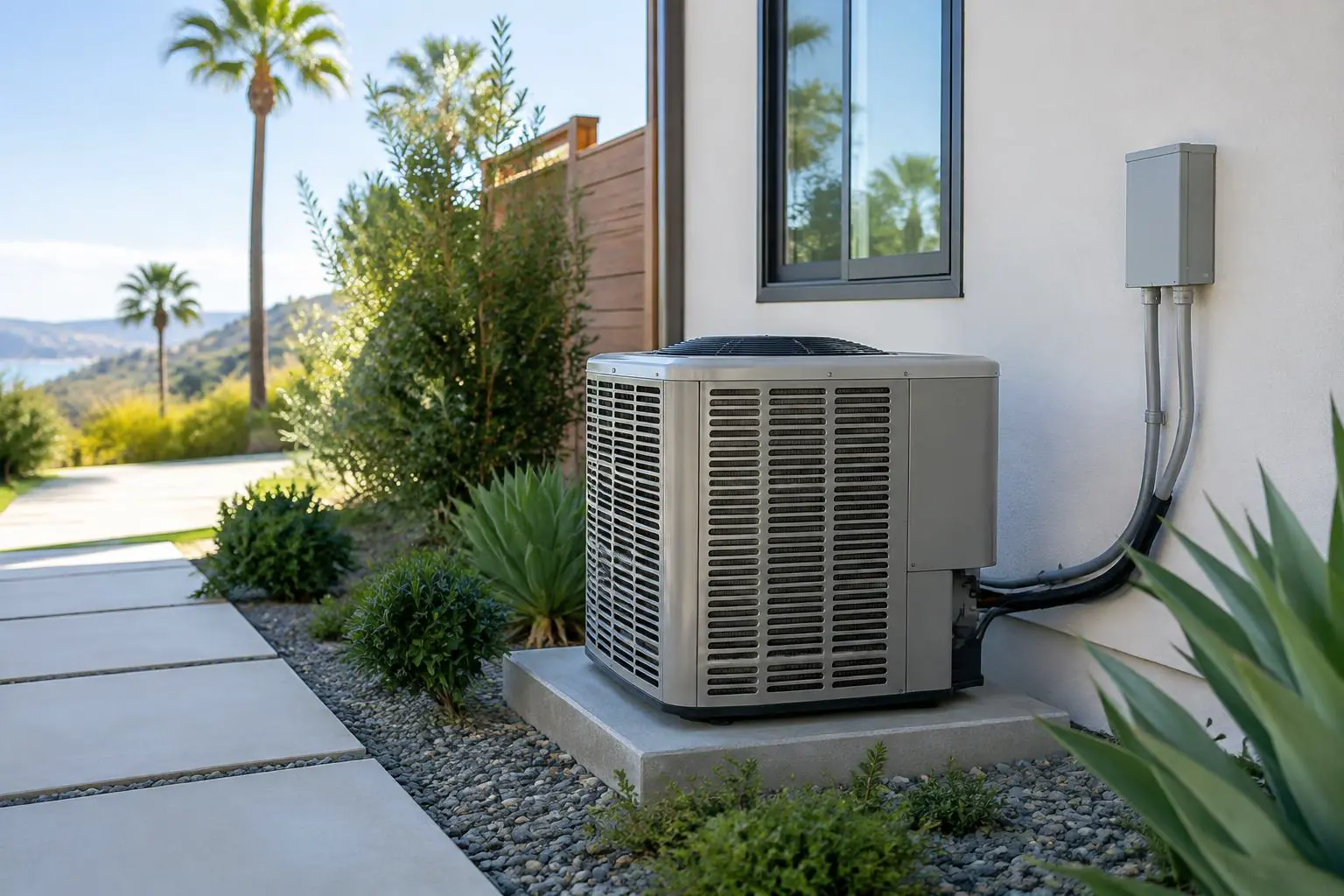
The Department of Energy says heat pumps use electricity to transfer heat rather than generate heat. In the cooling season, a heat pump moves heat from inside your home to the outdoors. In the heating season, it moves heat from the outside air into your home. That is why one system can replace both an air conditioner and a furnace.
ENERGY STAR describes two common forms. A ducted air-source heat pump can connect to the forced-air ductwork found in most homes. A ductless (mini split) heat pump does not need ductwork: one or more head units mount on an interior wall or ceiling and connect to an outdoor unit.
WHY A HEAT PUMP SUITS SOUTHERN CALIFORNIA HOMES
The Department of Energy describes heat pumps as an energy-efficient alternative to furnaces and air conditioners for all climates. A heat pump heats and cools with one outdoor unit and suits Southern California's mild winters, and many homes are good candidates. We compare it with an AC and furnace setup for your house.
Your address still matters. NOAA explains that the marine layer forms when cold ocean water cools the air above it, and the National Weather Service in San Diego says the weather can be very different between beaches and inland areas. A home near the water and a home farther inland can ask different things of the same system, so we size from the house rather than the city.
HEAT PUMP OR AC PLUS FURNACE?
An AC and furnace are two pieces of equipment, one to cool and one to heat. A heat pump does both. ENERGY STAR says that in most zones an air-source heat pump can be installed as a drop-in replacement when a central air conditioner or furnace needs replacing, but your ducts and electrical panel still need to be checked first. The Department of Energy also describes hybrid systems that pair a heat pump with a gas furnace.
| Question | Heat pump | AC plus furnace |
|---|---|---|
| What it does | Heats and cools with one system by moving heat | An air conditioner cools and a furnace heats, as two pieces of equipment |
| Ducts | Ducted models use the home's forced-air ducts; ductless models need none | A central AC and furnace typically share the home's forced-air ducts |
| Electrical | Runs on electricity, so we check your panel and circuits | We compare what your current equipment draws with what the new equipment needs |
| Permit and testing | A permit, plus the Energy Code duct and refrigerant charge verification described below | A permit, plus the Energy Code duct verification described below and, for air conditioners in some climate zones, refrigerant charge verification |
Our full comparison is in the guide linked below this section. It covers how each option works, the sizing question and what to ask any contractor.
DUCTED HEAT PUMP OR DUCTLESS MINI SPLIT?
The Department of Energy calls mini splits an efficient and flexible solution for homes without existing ductwork, and says they are generally the best retrofit option for those homes. Where ducts already exist, a ducted heat pump can use them if they are in good shape. At the assessment we look at your ducts and compare both options for your house.
| Question | Ducted heat pump | Ductless mini split |
|---|---|---|
| Ductwork | Connects to the home's forced-air ducts | Needs no ducts |
| Indoor equipment | Air moves through the existing ducts | One or more head units on an interior wall or ceiling |
| Where it fits | Homes with existing ductwork | Homes or sections of homes without ductwork, and rooms with hot or cold spots |
| What we check | The condition and layout of the ducts, and where the equipment will go | How many head units, where each goes and where the outdoor unit can sit |
CALIFORNIA RULES THAT COME WITH A HEAT PUMP INSTALLATION
Wherever you live, the same state rules shape a heat pump changeout. CSLB's HVAC checklist tells homeowners to make sure the contractor obtains a building permit and that the building department performs all required inspections. The California Energy Commission's 2025 Energy Code, which applies to buildings whose permit applications are applied for on or after January 1, 2026, adds testing to the permit.
- Duct sealing and verification: the Energy Commission says replacing the outdoor unit or the indoor unit of a split system, by itself, triggers duct sealing and field verification. An independent rater, called an ECC-Rater, verifies the result.
- Refrigerant charge: the Commission's compliance manual calls for refrigerant charge verification on heat pumps in all climate zones. For air conditioners it applies in climate zones 2 and 8 through 15.
Which tests apply depends on the equipment and your address. We do not assign climate zones to cities, so ask your contractor or building department which zone your address is in and which of these tests apply.
- CSLB: HVAC Installation Fact Sheets and HVAC Checklist for consumers (PDF) (opens in a new tab)
- California Energy Commission: 2025 Building Energy Efficiency Standards (opens in a new tab)
- California Energy Commission: 2025 Single-Family Heating, Ventilation, and Air Conditioning (HVAC) (opens in a new tab)
- California Energy Commission: 2025 Single-Family Residential Compliance Manual, Chapter 9 (alterations and repairs to existing homes) (opens in a new tab)
IF YOUR HOME IS IN AN HOA
If your home is in a homeowners association that requires approval for physical changes, Civil Code Section 4765 sets the ground rules for that review: the association's decision is to be in writing, and a disapproval has to explain why and describe how to ask for reconsideration. HOA approval and a city permit are separate. One does not replace the other.
An outdoor unit and its refrigerant lines can show from outside the house, so ask your association for its rules before the schedule is set, and give the association and the city the same drawings.
THE FREE ASSESSMENT
WHAT THE FREE IN-HOME ASSESSMENT COVERS
Load sizing
It depends on the home, not just the square footage. Insulation, windows, sun exposure and ductwork all change the load. We size the system to the house rather than simply matching the old unit.
Ductwork
We look at the condition and layout of your existing ducts. A ducted heat pump uses them, and the 2025 Energy Code adds duct sealing and verification when the outdoor or indoor unit of a split system is replaced. If a ductless mini split suits part of the house, we show you that option too.
Electrical capacity
A heat pump runs on electricity, so we check your panel and the circuits that will serve it, and tell you whether electrical work is needed before you commit.
Equipment
Golden Empire USA installs Goodman systems and can provide other brands on request. We compare ducted and ductless options for your home.
Permits and inspections
We pull the permits where the work requires them, and we coordinate the inspections and the Energy Code testing that follow.
Incentives and financing
Our team can check current utility and state incentive programs for your home. Programs change, so we do not list them here. Financing is available for qualified homeowners. Ask at your free assessment.
FINANCING
FINANCING AVAILABLE
Financing available for qualified homeowners. Ask at your free assessment.
Financing is subject to credit approval. Terms vary. Golden Empire USA is not a lender.
Learn about financing →FAQ
HEAT PUMP INSTALLATION FAQS
What is a heat pump?
A heat pump is a heating and cooling system that moves heat instead of generating it. In summer it moves heat from inside your home to the outside, and in winter it moves heat from the outside air into your home.
Is a heat pump a good fit for Southern California homes?
Many homes are good candidates. A heat pump heats and cools with one outdoor unit and suits Southern California's mild winters. We'll compare it with an AC and furnace setup for your home.
How is a heat pump different from an AC and furnace?
An AC and furnace are two pieces of equipment, one to cool and one to heat. A heat pump does both with one system. Our guide on heat pumps versus an AC and furnace compares them side by side.
Do I need ductwork for a heat pump?
A ducted heat pump uses your home's ducts when they are in good shape. A ductless mini split does not need ducts. We check your ducts at the assessment and compare both options. We replace ductwork when the existing ducts are damaged, leaking or undersized for the new system.
Will my electrical panel need an upgrade?
Sometimes. A heat pump runs on electricity, so we check your panel and circuits at the assessment and tell you whether electrical work is needed before you commit.
What size heat pump do I need?
It depends on the home, not just the square footage. Insulation, windows, sun exposure and ductwork all change the load. We size the system to the house rather than simply matching the old unit.
What brands do you install?
Golden Empire USA installs Goodman systems and can provide other brands on request.
Do you pull the permits?
Yes, where the work requires them. We also coordinate the inspections and the Energy Code testing that follow.
Are there rebates or incentives?
Our team can check current utility and state incentive programs for your home. Programs change, so we do not list them here.
Do you offer financing?
Financing is available for qualified homeowners. Ask at your free assessment, and see our financing page for details.
Is Golden Empire USA licensed?
Yes. Golden Empire USA holds California contractor license #490516, and you can verify it on the CSLB website or on our license page.
How do I get started?
Request a free in-home assessment by phone or with the form on this page. We look at your system and your home first.
KEEP READING
HEAT PUMPS NEAR YOU
Heat pump installation by city
Permit offices, state Energy Code rules and coastal and HOA notes for these cities:
- Heat pump installation in Carlsbad
- Heat pump installation in Encinitas
- Heat pump installation in Oceanside
- Heat pump installation in Costa Mesa
- Heat pump installation in Dana Point
- Heat pump installation in Huntington Beach
- Heat pump installation in Irvine
- Heat pump installation in Mission Viejo
- Heat pump installation in Newport Beach
- Heat pump installation in San Clemente
- Heat pump installation in Tustin
Related guides
Sources
- U.S. Department of Energy, Energy Saver: Heat Pump Systems (opens in a new tab)
- ENERGY STAR: Air-Source Heat Pumps (opens in a new tab)
- ENERGY STAR: Ductless Heating & Cooling (opens in a new tab)
- NOAA JetStream: The Marine Layer (opens in a new tab)
- National Weather Service San Diego: The Weather Guide, 6th Edition, 2012 (PDF) (opens in a new tab)
- CSLB: HVAC Installation Fact Sheets and HVAC Checklist for consumers (PDF) (opens in a new tab)
- California Energy Commission: 2025 Building Energy Efficiency Standards (opens in a new tab)
- California Energy Commission: 2025 Single-Family Heating, Ventilation, and Air Conditioning (HVAC) (opens in a new tab)
- California Energy Commission: 2025 Single-Family Residential Compliance Manual, Chapter 9 (alterations and repairs to existing homes) (opens in a new tab)
- California Civil Code Section 4765 (association architectural review) (opens in a new tab)
Last reviewed . Codes, permit rules and equipment requirements change, so confirm current requirements with the building department before work starts.
FAMILY & VETERAN-OWNED
GET YOUR FREE IN-HOME HEAT PUMP ASSESSMENT
We'll look at your current system and ductwork first.